
Mindful Way Counseling accepts most major private commercial insurance plans, as well as some state funded plans. This includes most plans by the following companies:


- Commercial & Private Insurance, including those purchased on the MN marketplace known as MNSure: We participate with a wide range of major private health insurance providers (individual plans may vary).
- Straight Medical Assistance (MA): We accept Medical Assistance through the State of Minnesota as a standalone primary coverage plan, when you are covered under no other plans. We also accept these plans when MA is secondary to a plan that we are in-network with.
- Managed Care & State-Subsidized Plans: We accept most MNCare and Medical Assistance PMAP plans, provided they are managed by one of our accepted commercial insurance carriers shown above.
Always check with your insurance to be sure that we are in network. For supervised clinicians, ask about the network status of Mindful Way Counseling or their supervisor’s name.
Before scheduling, please review the specific programs we are unable to bill. Mindful Way Counseling does not participate with and cannot bill:


- Medicare Plans: We cannot process insurance claims for any Medicare members. This applies even if your secondary or supplemental insurance is a network we accept.
- Hennepin Health PMAP: We are not in-network with Hennepin Health Community Health Plan. (Please note: We may also be out-of-network with certain regional PMAP plans operating outside the core Twin Cities metro counties).
- Employee Assistance Plans (EAPs): We generally do not accept EAP benefits. Pre-licensed therapists cannot bill EAPs at all. Fully licensed providers are rarely credentialed with EAPs. Even if your EAP is managed by a commercial insurance carrier we accept for standard health coverage, that contract does not automatically extend to EAP authorizations.
Using your health insurance is a fantastic way to make therapy more affordable. By using an in-network insurance plan, you receive access to a significantly discounted rate compared to a standard private pay out-of-pocket fee.
Because every insurance policy is unique, each individual plan dictates the final out-of-pocket cost:
- Certain state-funded programs (like MA, PMAPs, MNCare) often cover your counseling sessions in full.
- Commercial plans will outline specific cost-sharing responsibilities like co-pays, deductibles, or coinsurance. For a visual breakdown of how these terms breakdown your bill, take a look at our Insurance 101 infographic.
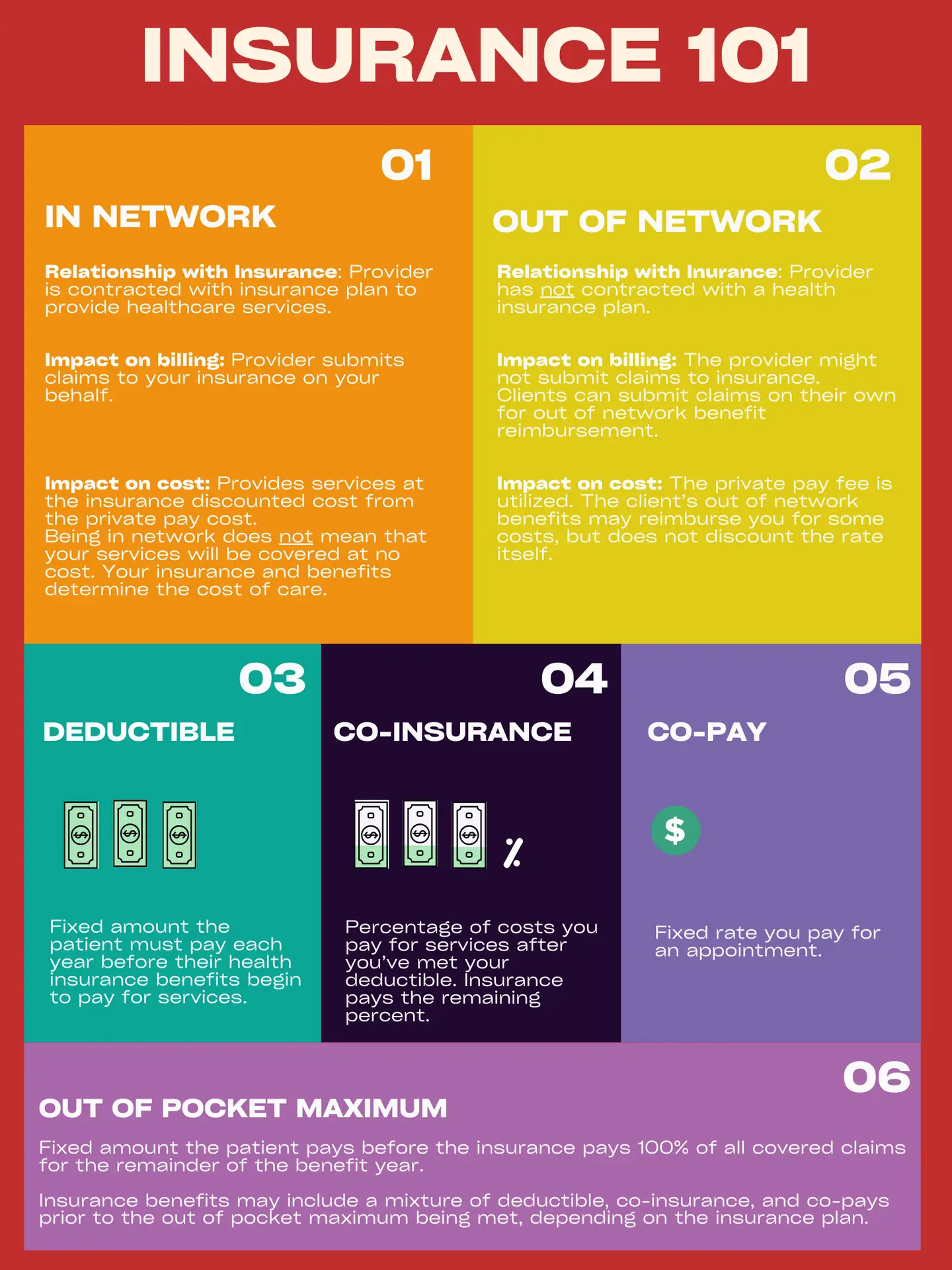
When you carry more than one health insurance policy, both plans share responsibility for your care.
However, please note that neither Mindful Way Counseling nor our clients can choose which insurance plan to use—or which order to use them in—for appointments.
Insurance regulations strictly determine which policy acts as your primary payer, secondary payer, and so on. We are legally required to follow this precise order for all claim submissions. To avoid unexpected billing errors or denials, please ensure our intake team has up-to-date details for every active policy you hold. We appreciate your transparency and understanding!
Maintaining active and accurate insurance information on file is essential to avoid unexpected out-of-pocket costs.
To ensure your claims are processed correctly, we require all updated insurance details to be submitted one week prior to your next session.
- Terminated Coverage: If your insurance coverage ends at any time, you will become financially responsible for all therapy services received after the date your coverage terminated.
- Late Updates: Sessions held before updated insurance information is received will be billed directly to the client.
- Missed Sessions: In alignment with our clinic policies, clients are solely responsible for fees associated with missed appointments and late cancellations, as insurance cannot be billed for these events.
You can find additional information about financial responsibilities outlined in our Policies.
Yes. We welcome clients who choose to private pay.
To review the cost of your care, please reference our private pay fee document. You can easily verify which pricing tier applies to your care by checking the credentialing details located directly within your provider’s bio.
- Payment at Time of Service: All out-of-pocket costs are due in full at the time of your therapy appointment.
- Clients who do not have insurance, are out of network, or those who are choosing to opt out of their network benefits, will be provided with the appropriate insurance opt-out form and private pay agreements, including the Good Faith Estimate.
Under the federal No Surprises Act, health care providers must give clients who are uninsured or opting out of insurance an estimate of the expected costs for care. At Mindful Way Counseling, transparency has always been a core value.
- Your Right to a Good Faith Estimate:
You have the right to receive a written estimate for the total expected cost of your therapy services before your sessions begin. To complete this, we utilize the information you provide on your initial intake request form. We will then upload your personalized Good Faith Estimate directly to your client portal as part of your digital new client paperwork prior to your first appointment. (For a complete review of our private-pay rate tiers, please see the section below: “What if I am out of network or I want to private pay?”)
- The Right to Dispute:
If you receive a bill that is $400 or more higher than your official Good Faith Estimate, federal law allows you to dispute the bill. Be sure to save or screenshot a copy of your estimate for your records.
- Clarity Regarding Outpatient Level of Care:
Please note that these federal protections are primarily designed to prevent unexpected costs in hospital settings (such as emergency room visits or hidden out-of-network doctors). Because our private-pay fees and clinician tiers are always listed right on our website, your costs will always be fully transparent and available to you from day one.
For a deeper look at your federally protected rights, you can read our full No Surprise Act & Good Faith Estimate Disclosure Page, or visit the official government portal at www.cms.gov/nosurprises.